The scale of one self-play training
How it works
Every agent acts, is rendered for its neighbors, and learns from what it sees, all within one closed loop. Perception and control are learned jointly.
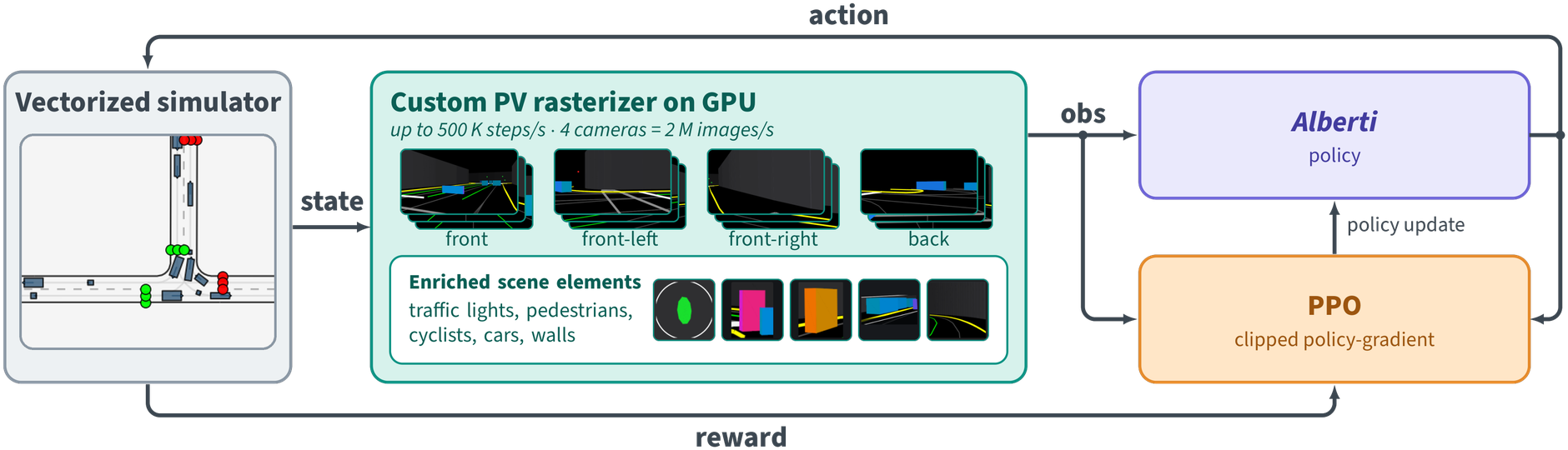
Pictura couples a vectorized simulator with a custom GPU rasterizer that renders the simulator state into each agent's egocentric perspective view. The observation feeds Alberti, the policy, and, together with the action and the reward, forms the rollout that PPO turns into a policy update.
How fast the renderer is
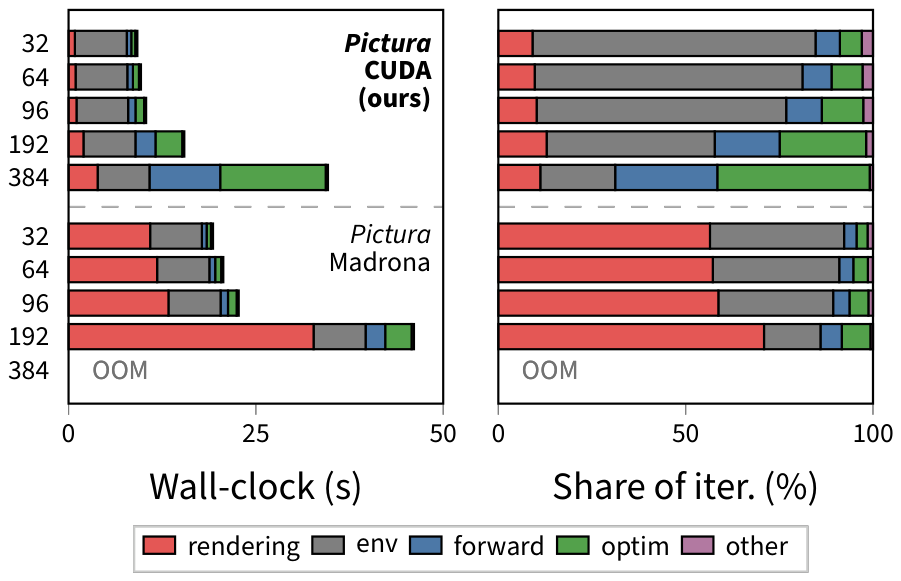
Perspective self-play is practical only if rendering is cheap. Pictura's CUDA rasterizer runs ahead of state-of-the-art perspective renderers, and it gets faster on newer hardware optimized for deep-learning training.
A new state of the art that scales with hardware. 1.4–4.1× over the best prior setting, and 1.5× again from A100L to H100.
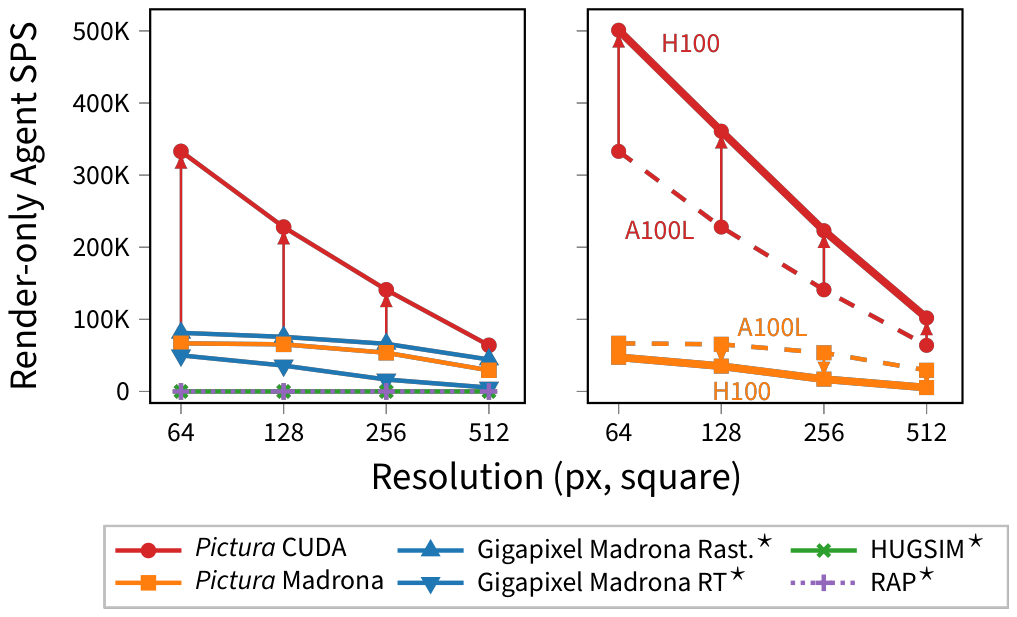
No longer the bottleneck. Rendering takes about 10% of a training step, against more than half on Madrona.
Watching the policy drive
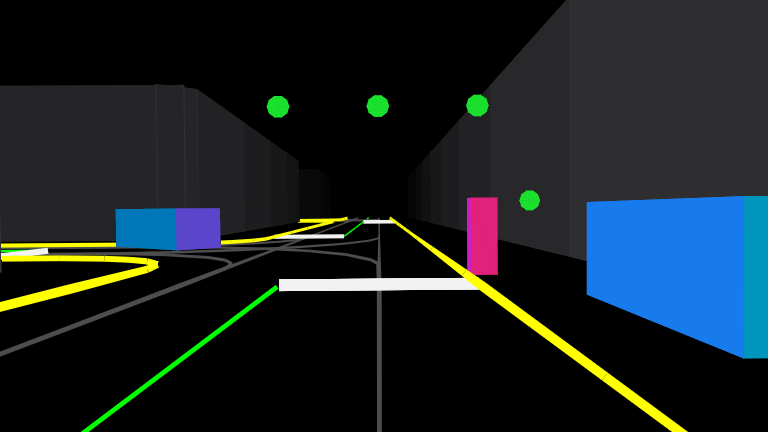
Each clip is 25 seconds of self-play by Alberti 50 B, showing exactly what the policy receives: the four cameras of its rig, rendered at 96×54 pixels by Pictura inside the training loop. Within a family every face carries its own hue, so an object's heading reads from its shading. Click any clip for a higher-resolution render, for viewing only.
vehicles pedestrians cyclists buildings road edges road lines crosswalks lane centers
Traffic density
These clips show Alberti driving in Town10HD across light, medium and dense traffic.
Grounding in what the cameras see
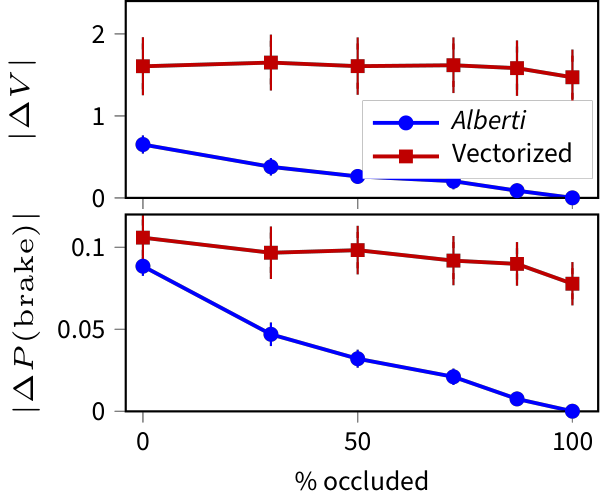
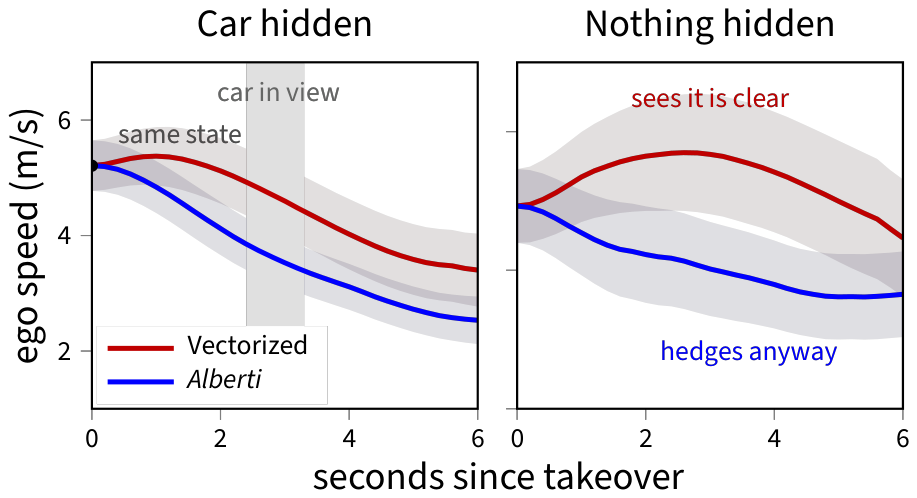
Two probes ask what Alberti and a privileged vectorized policy (same training recipe, but reading exact state) actually base their decisions on.
Counterfactual probes. Alberti's response falls as occlusion rises and reaches zero once the road user is hidden, while the privileged policy stays sensitive to agents no camera could see.
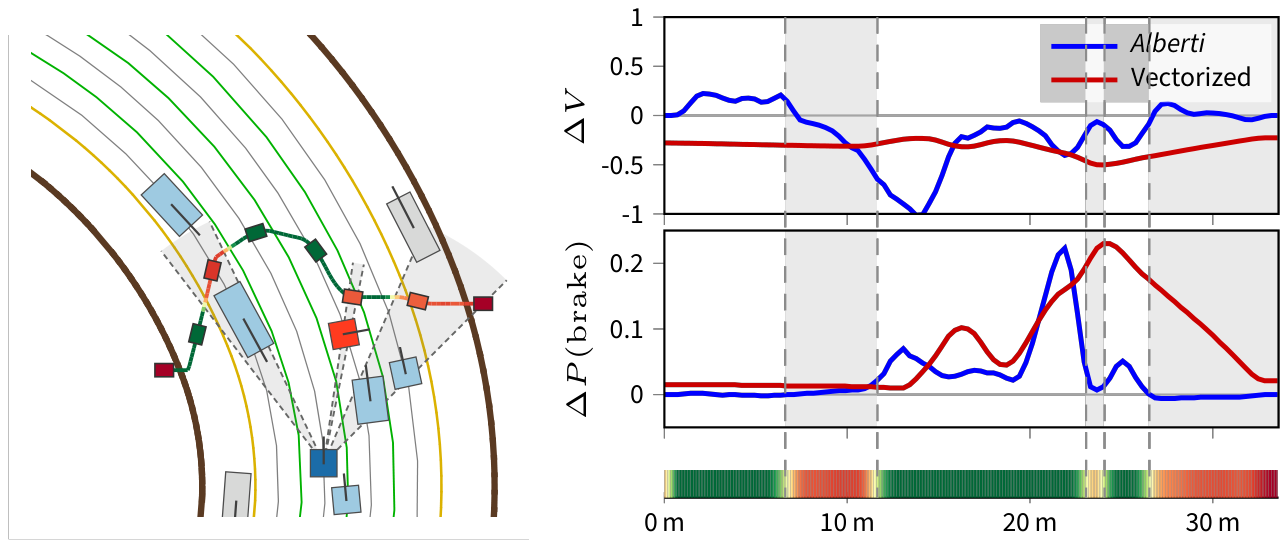
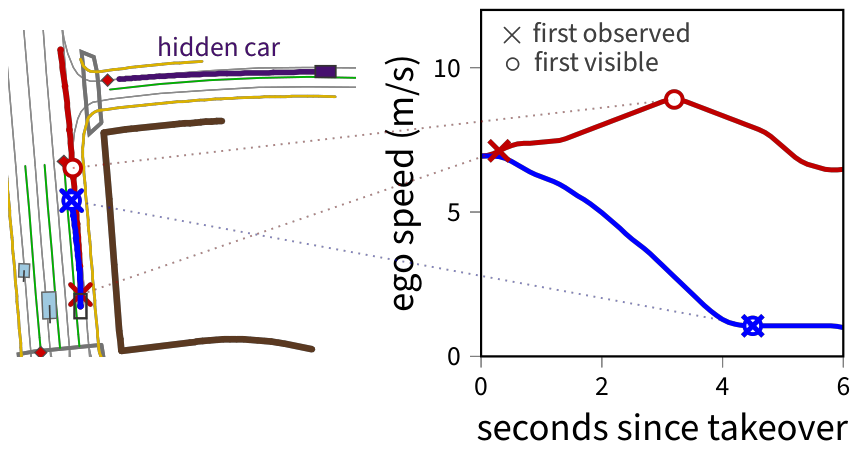
Blind corners. Alberti approaches a corner hiding an oncoming car more slowly, so it is further away when the car appears — caution a privileged expert has no reason to learn.
Citation
@article{yin2026pictura,
  title         = {Pictura: Perspective-View Self-Play at Scale for Driving},
  author        = {Yin, Yuan and Ramzi, Elias and Lafon, Marc and Charraut, Valentin
                   and Bares, Victor and Xu, Yihong and Zablocki, {\'E}loi and Boulch, Alexandre
                   and Buhet, Thibault and Bursuc, Andrei and Cord, Matthieu},
  year          = {2026},
  eprint        = {2607.26005},
  archivePrefix = {arXiv},
  primaryClass  = {cs.CV}
}